ID-7-P-5897 Microscopic evidence of painting damage as a result of saponification
There are many reasons why pigments and binders degrade in colour layers of paintings. Some of them are chemically unstable by their nature; others interact with each other in mixtures. They could be also influenced by external factors - lighting, humidity, added chemicals (e.g. via inappropriate conservation treatment). The fatal consequences arise when degradation processes lead to colour changes or loss of mechanical integrity of painting layers. A typical representative of the second alternative is a process known as saponification of lead pigments. These pigments react with fatty acids contained in oil components of the binding media, slowly dissolve and finally form the so-called ‘metal soaps’, which are highly mobile and are able to diffuse and migrate through the layers. Therefore, the best example of saponification one can find in oil paintings containing large amounts of lead white (basic lead carbonate), e.g. in Netherlandish and Flemish paints of the 17th century (the Dutchmen were famous for their production of high-quality lead white). Other pigments, however, as red lead (Pb3O4), lead-tin yellow (Pb2SnO4 or PbSnO3) and other ones, could potentially react in similar way. Microscopy is an effective tool, how to reveal the process already in its initial stages. At an advanced stage, metal soaps aggregate and form prominent whitish or translucent lumps, which expand rapidly until they finally break through the paint surface causing paint loss and/or visual disruption of the surface. Within the extensive research we have evidenced the formation of metal soaps surprisingly also in Gothic tempera paintings where they appear accordingly with increased proportions of fatty ingredients in the binder (the so-called “fatty” tempera paints). We also observed that the process of saponification could affect the clay-based ground layers of Baroque paintings in cases where red earths were mixed with orange minium as an additional colorant. Metal soaps, indicated by their typical morphology, colour, UV luminiscence and chemical composition, thus seem to be more frequent than expected.
The authors thank restorers Mario Král and Blanka Valchářová for fruitful cooperation. Financial support of the Czech Science Foundation, project no. P103/12/2211, is kindly acknowledged.
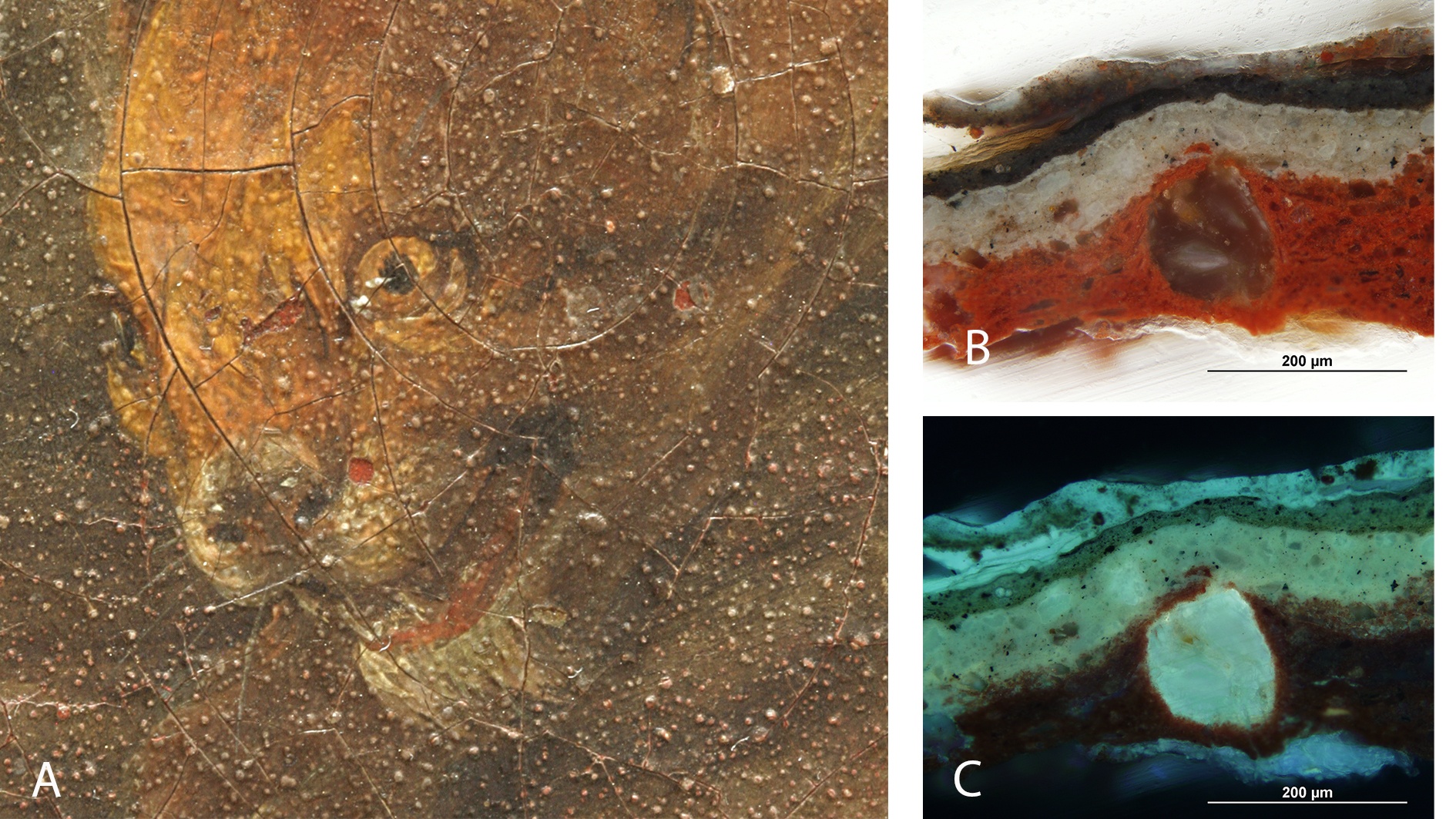
Fig. 1: Lead soap aggregates protruding through the paint surface of the 17th century oil painting Leopards attacking deer by Carl Andreas Ruthart (1630 - 1703) (A) and detail of one individual lump in the microsection, formed by reaction of red lead with oil component of the binder in the red ground layer – in visible (B) and UV light (C), respectively. |
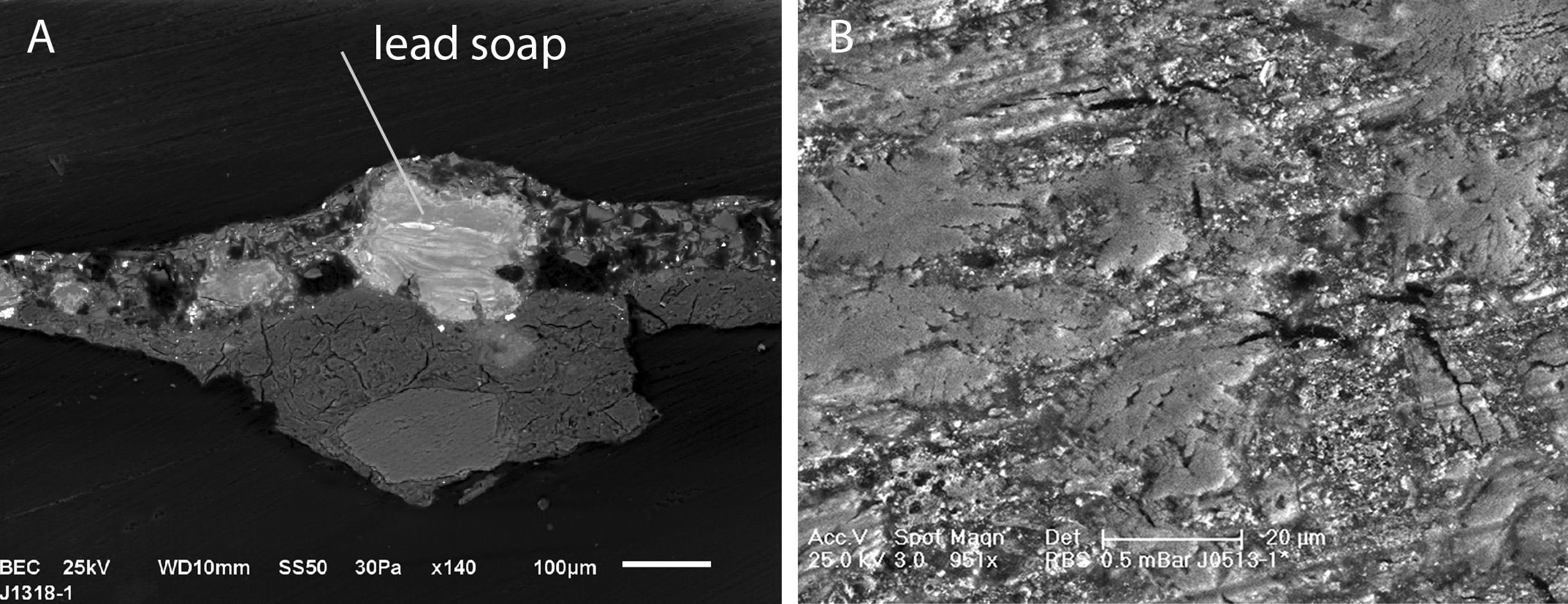
Fig. 2: Morphology of lead soaps in back-scattered electrons – formed by reaction of lead white (A) and lead-tin yellow (B), respectively, in painting layers of 18th century paintings. |