MS-4-P-5797 TEM microstructure characterizations of Al-Mg-Si aluminum alloy processed by severe plastic deformation
Nanostructured materials (NSM) processed by severe plastic deformation (SPD) have provided new opportunities for nanostructure refinements in metals and alloys with unusual properties which are very attractive for various structural and functional applications [1]. In the present work, a commercial 6061 Al-Mg-Si alloy (Al-1.0Mg-0.6Si in wt.%) was processed by equal channel angular pressing (ECAP) at 110 °C. Post ECAP microstructure characterization was carried out by using a JEM2010 (HRTEM).
All SPD procedures rely upon imposing a very heavy strain to the material so that a very high dislocation density is formed. By using the weak-beam dark-field (WBDF) method under special diffraction conditions, dislocations can be imaged as narrow lines. Figure 1(a) and (b) show WBDF TEM micrographs of dislocations in an ECAPed alloy by using the diffraction vectors, g =11-1 and g = 200 respectively. Under the present ECAP condition, the average projected dislocation density expected to be in the order of 1.4x10E17m-2 [1]. However the observed dislocation density in Fig.1 is much lower than this, suggesting that the majority of perfect (unit) dislocations had already passed through the Al alloy during the ECAP process. This can be further confirmed in the HRTEM image of Fig.2, where typical dislocation structures involve two partial dislocations connected by a stacking fault. The detailed configurations of partial dislocations in the present face-centered-cubic Al system has earlier been reported by the present authors [2], and an example is shown in Fig. 2(b) where a unit screw dislocation dissociated into two 30 ° partial dislocations connected by an intrinsic stacking fault is seen. The precipitation sequence in this alloys is generally accepted to be supersaturated solid solution → GP-I (II) zones → β’’ → β’. All these hardening phases are formed by nucleation and growth along Al {100} planes. Figure 3(a) shows a low magnification micrograph under multi-beam bright-field TEM mode from one [001] orientated Al grain. The homogenous disk-like precipitates can be found in the figure. Further HRTEM results of these disks-like precipitates microstructure are shown in Fig. 3(b), where it can be seen precipitates without any obvious lattice structure. These precipitates could be identified at very initial stage of dynamic precipitation.
TEM microstructure characterizations revealed most possibly in supersaturated solid solution is identified from the HRTEM investigations. Dislocation distribution investigations by using WBDF TEM reveal that most unit dislocations possibly already passed through this Al alloy during ECAP, which could also serve as driving force for promoting present dynamic precipitation.
MP Liu gratefully acknowledges funding from the National Natural Science Foundation of China (NSFC) under grant number 50971087.
[1] AP Zhilyaev and TG.Langdon, Progress in Materials Science 53 (2008), p. 893.
[2] MP Liu, HJ Roven and YD Yu, Zeitschrift für Metallkunde, 3 (2007), p. 184.

Fig. 1: Weak-beam dark-field TEM micrographs show dislocation microstructures by using diffraction vectors of (a) g = 11-1 from Al [011] orientation and (b) g = 200 from Al [001] orientation. |

Fig. 2: (a) Typical dislocation structure in Al [011]. (b) A unit screw dislocation dissociated into two 30 ° partial dislocations connected by an intrinsic stacking fault. |
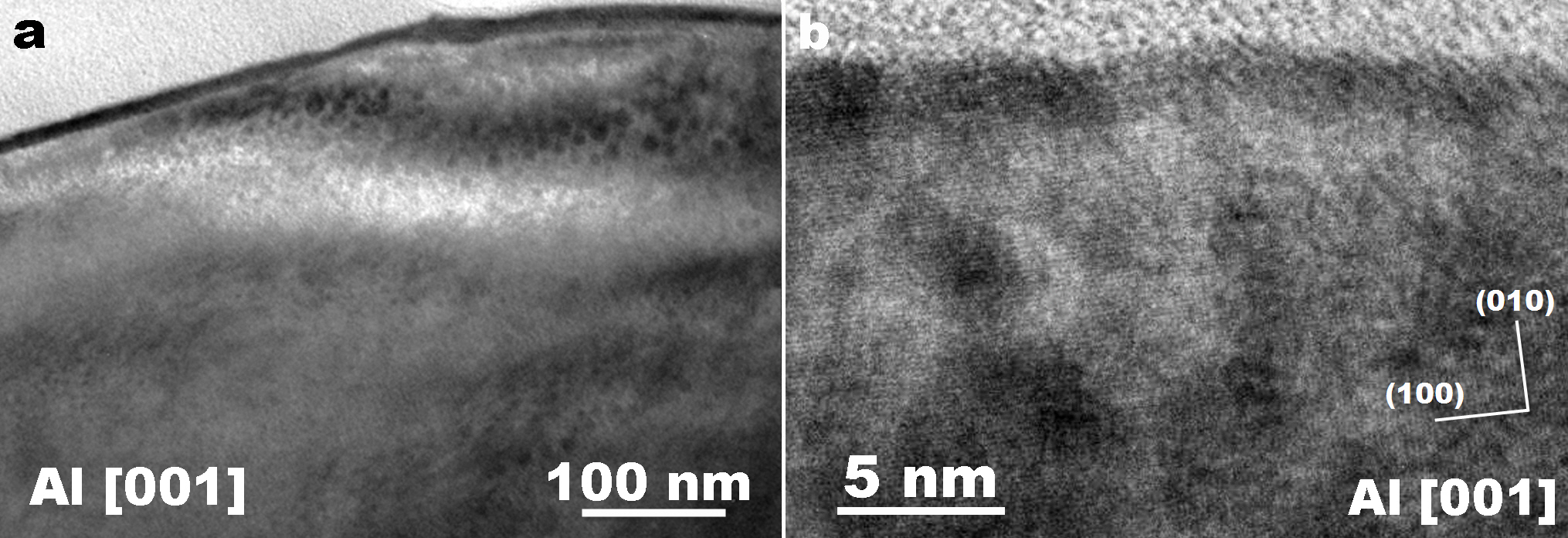
Fig. 3: (a) Bright-field TEM micrograph shows homogenous precipitates, and non-sharp precipices on the lower part image are caused by specimen bending and locally missed accurate Al [001] orientation. (b) The corresponding HRTEM image shows precipitate lattice structure. |
|