MS-10-P-3453 Morphological and chemical characterization of sandstone from Constantine, North-East of Algeria.
The north-east area of Constantine has a very complex geological site.
The variety of sedimentary rocks such as sandstone in abundance represents a big importance in the industry and road infrastructure.
Aggregates are the major constituents of concrete and typically occupy a large proportion of its volume. The concrete’s properties are mainly influenced by the quality of the aggregates.
Sandstone is a widespread aggregate resource and it is increasingly being used in concrete construction around the world.
The geological properties of this sedimentary rock are fairly diverse such as quartzite aggregate that may produce a range of hardened concrete properties. Therefore, it is important to study and characterize the aggregate to obtain predictable concrete properties.
The Environmental Scanning Electron (ESEM/EDS) and Optical Microscopy are to study the morphological aspect of the existing phases. X- Ray Diffraction (XRD) and Fourier Transform Infrared Spectroscopy (FT-IR) analysis of sandstone are required to investigate the structural properties of them.
The SEM morphology coupled with EDS analysis shows what has been observed by previous techniques, confirms the existence of elements proportions.
The electron microscopy observations show that the extracted samples (Fig. 1) have morphology with angular grains of quartz with an average size from 10 to 30 μm. One can observe that these grains are covered with fine particles of calcite.
The optical observations reveal the presence of different oxides and the intergranular phyllosilicates such as: the Montmorillonite (Na, Ca)0,3(Al, Mg)2Si4O10 or the Kaolinite ( Al2Si2O5 ) as minor elements.
The XRD spectra reveal the present phases, that confirmed by using the Infrared spectroscopy (Fig.2) through their vibrational modes.
The combination of these advanced techniques, which were not designed with the purpose of answering geological or environmental questions, can generate complementary of geological materials and opening up new approaches in the study of porous geomaterials.
All authors thank, the Process Engineering Laboratory, University of Bejaia and Birine Nuclear Center, Ain Ouassera, Algeria for their collaboration.
All authors thank, the Process Engineering Laboratory, University of Bejaia and Birine Nuclear Center, Ain Ouassera, Algeria for their collaboration.
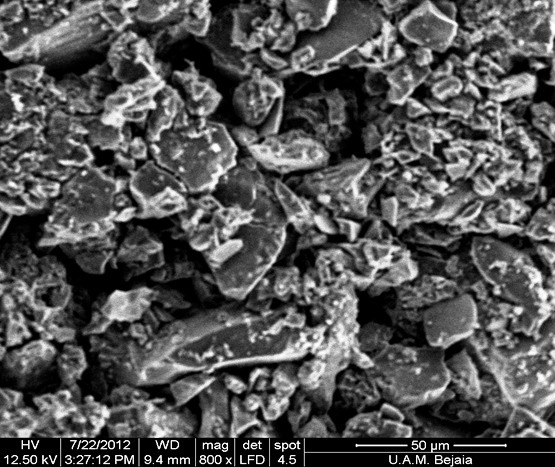
Fig. 1: SEM morphology of sandstone (X 1600): angular grains of quartz size around: 10 to 30 [μm], covered with fine particles and the grains of calcite. |
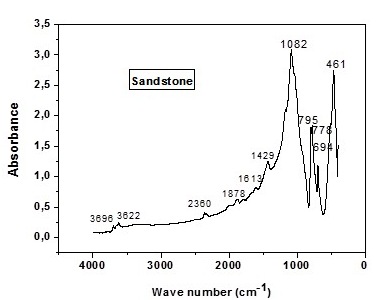
Fig. 2: We can note that the Sandstone are mainly composed of quartz (1429, 1082, 778, 694, 461 cm-1). Low Intensity peaks can be seen 3500 and 4000 cm-1 corresponding to oxygen-hydrogen bonds HOH, which indicate the presence of clay type compounds. |