IT-16-P-3170 Structure factor refinement from electron diffraction for structures with arbitrarily large unit cells
Structure-factor refinement by quantitative convergent-beam electron diffraction (QCBED) [1] has been able to reveal the charge distribution responsible for the bonding between atoms [2]. However, in order to be able to fit a set of complex structure factors by comparing dynamical electron diffraction simulations to the contrast within CBED discs, the sample must typically be at least 100 nm thick, and the lattice parameters should not exceed 1 nm. Also, in order to extract the elastic scattering signal it must be assumed that the incoherent background (mainly thermal diffuse scattering (TDS)) varies only slowly, an assumption that is not generally correct. In contrast, large-angle rocking-beam electron diffraction (LARBED) [3] data (see, for example Fig. 1) can be acquired for arbitrarily large unit cell structures and reveals features that are clearly due to dynamical electron diffraction even at specimen thicknesses below 10 nm. This makes structure factor refinement from nanocrystals possible.
As is common in QCBED work we write the scattering matrix S in the form S=eiTA, by assuming previous knowledge of the excitation errors (diagonal of A), we reduce the problem to finding the factor T, which is acceleration voltage and specimen thickness related, and all the off-diagonal entries Ug-h in A, from a series of observed norms of entries in one column of S (the squared norms correspond to the diffraction intensities shown the example pattern in Fig. 1). To efficiently solve such a nonlinear programming problem up to several hundreds of variables, a gradient-based iterative method is critical.
In this work, we design a two-layer model to accelerate the calculation of the expensive Bloch-wave simulation and the cumbersome gradient approximation. We also compare and discuss the convergence and performance of different optimization algorithms applied to this problem.
[1] C. Deininger, G. Necker, J. Mayer, Ultramicroscopy 54 (1994) 15-30
[2] J.-M. Zuo, M. Kim, M. O’Keefe, J.C.H. Spence, Nature 401 (1999) 49
[3] C.T. Koch, Ultramicroscopy 111 (2011) 828 – 840
The authors acknowledge the Carl Zeiss Foundation as well as the German Research Foundation (DFG, Grant No. KO 2911/7-1)
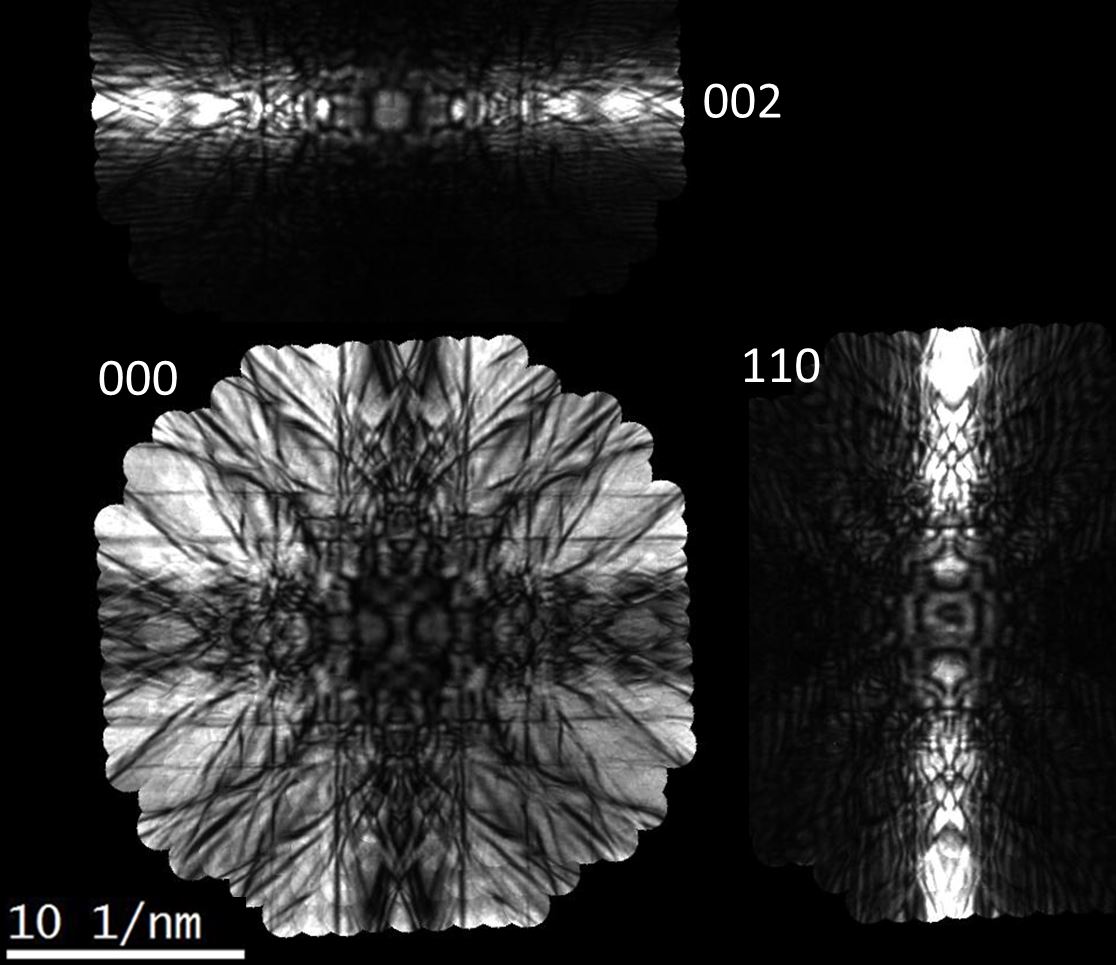
Fig. 1: Bright-field and dark-field large-angle rocking convergent beam (LARBED) patterns of SrTiO3 in the [-110] zone axis, acquired on the Zeiss SESAM operated at 200 kV. This kind of data can be used to fit dynamical scattering equations to, even for very thin samples. |