MS-1-P-3159 Wurtzite ZnO/Zinc Blende ZnS Coaxial Heterojunctions and Hollow Zinc Blende ZnS Nanotubes: Synthesis, Structural Characterization and Optical Property
Synthesis of ZnO/ZnS heterostructures in thermodynamic conditions generally results in the wurtzite (WZ) structure of the ZnS component because its WZ phase is thermodynamically more stable than its zinc blende (ZB) phase. In this report, we demonstrate for the first time the preparation of ZnO/ZnS coaxial nanocables composed of single crystalline ZB structured ZnS epitaxially grown on the WZ ZnO nanorod via a two-step thermal evaporation method. The deposition temperature is believed to play a crucial role in determining the crystalline phase of ZnS. Through a systematical structural analysis, the ZnO core and the ZnS shell are found to have an orientation relation of (0002) WZ ZnO//(002) ZB ZnS and [01-10] WZ ZnO//[2-20] ZB ZnS. Observation of the coaxial nanocables in cross-section reveals the formation of voids between the ZnO core and ZnS shell during the coating process, which is probably associated with the nanoscale Kirkendall effect known to result in porosity. Furthermore, by immersing the ZnO/ZnS nanocable heterojunctions in an acetic acid solution to etch away the inner ZnO cores, hexagonal shaped ZnS nanotubes orientated along the [001] direction of ZB structure were also achieved for the first time. Finally, the optical property of the hollow ZnS tubes was investigated. It was found that the tubes can give a strong green emission which may originate from some self-activated centers, vacancy states, interstitial states or structural defects. However, for those tubes with residual ZnO located on tops, they showed much lower emission intensity due to the type-II band alignment of ZnO/ZnS heterojunction that can efficiently decrease the recombination of the electron-hole pairs in both ZnO and ZnS. Our study gives some insights on the controlled fabrication of 1D semiconductors with desired morphology, structure and composition and the as-synthesized WZ ZnO/ZB ZnS coaxial nanocables and ZB ZnS nanotubes provide ideal candidates for the study of optoelectronics of II-VI semiconductors at the nanoscale.
We thank the financial support from the “Strategic Priority Research Program" of the Chinese Academy of Sciences (XDA09040203).
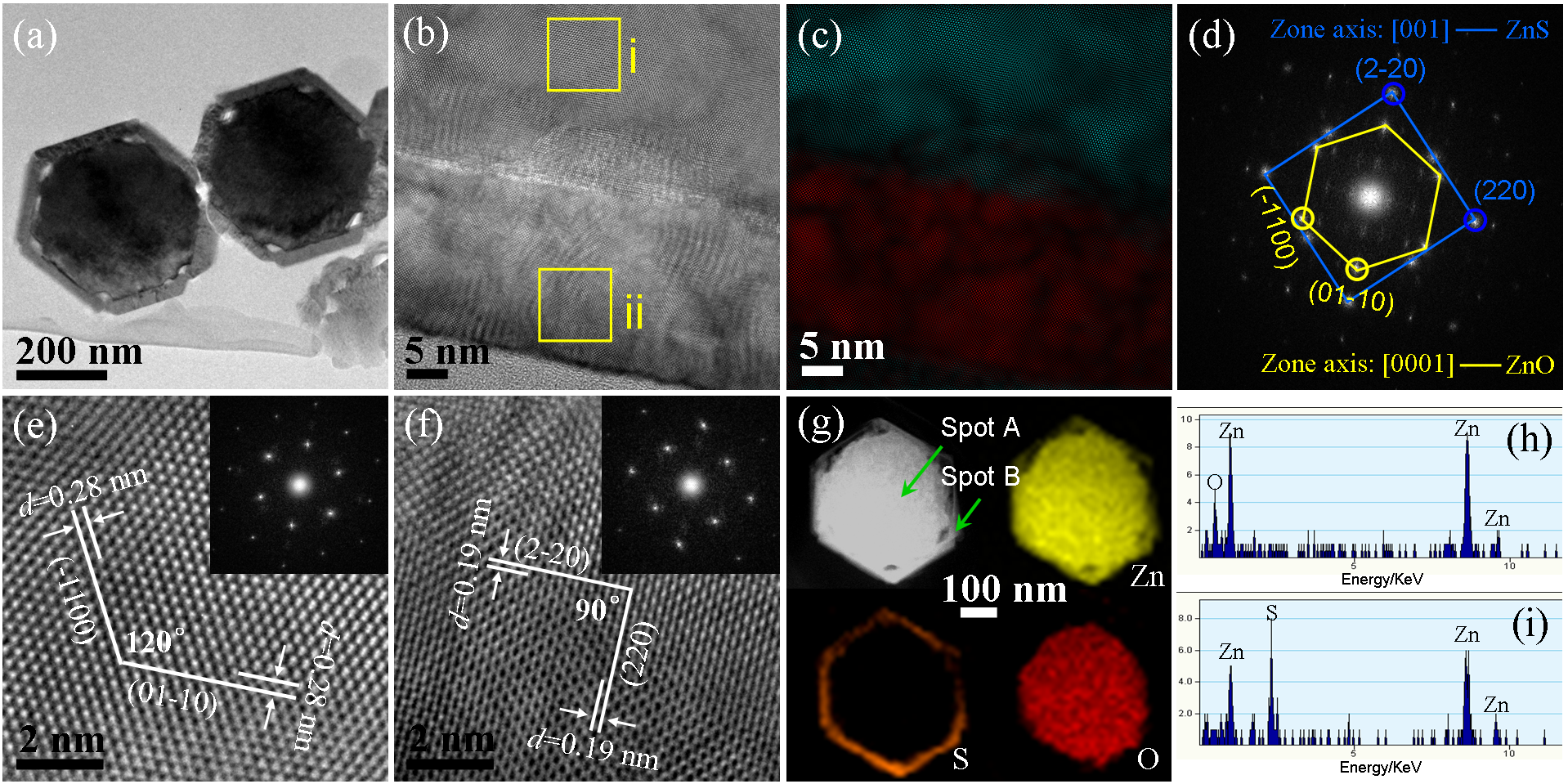
Fig. 1: (a) TEM image of the nanocables’ cross-sections; (b) HRTEM image and (c) reconstructed structure from (b), cyan: ZnO, red: ZnS; (d) FFT of (b); (e-f) Enlarged HRTEM image recorded from regions of i and ii of (b); (g) HAADF image as well as elemental mapping ; (h-i) EDX data corresponding to spots A and B, respectively. |