MS-9-O-3021 Charge-Density Wave and Domain-Contrast Reversals in aThree-Dimensional Material System Observed by TransmissionElectron Microscopy
The charge-density wave (CDW) is an electronic ground state with broken translational symmetry brought by correlated electron-phonon interactions. Decades of studies on the subject have established that a highly anisotropic band structure is essential for the emergence of this ground state and is characteristic to a wide spectrum of low-dimensional materials. Indeed, CDW has been largely found in one-dimensional (1D) and two-dimensional (2D) material systems such as NbSe3 and TaSe2. The existence of CDW in three-dimensional materials is usually not expected. It is not found until recently that the tetragonal rare-earth transition-metal silicide system with three-dimensional crystallographic structure R5T4Si10, where R is Dy, Ho, Er, Tm, and Lu, and T = Ir and Rh, can exhibit CDW phase transitions. Here, we report the investigations of CDW in Dy5Ir4Si10 at different temperatures using transmission electron microscopy (TEM) techniques including electron diffraction (Figure 1) and dark-field superlattice imaging. Incommensurate superlattice diffraction spots along c axis were observed in the electron diffraction patterns (Figure 2) when the sample was cooled below the well-known CDW transition temperature at ~208 K. CDW becomes commensurate with further cooling and configurations of CDW dislocations imaged by the dark-field technique convincingly show that the CDW phase transition is accompanied by a concomitant cell-doubling structural phase transition. Intriguingly, the cell-doubling transition is featured by an inversion-symmetry breaking observed by further convergent beam electron diffraction. A disparity in the CDW modulation vectors, q+ and q-, readily arises, breaking the CDW principle that the associated modulations should remain invariant upon spatial inversion. Upon dark-field imaging using respective q+ and q-, we surprisingly observed the contrast reversal of the CDW domains (Figure 3), a phenomenon largely undocumented in the past. The potential linking of this discovery to the emergent chiral CDW, which allow the breakdown of the spatial-invariant principle, was discussed.

Fig. 1: Electron diffraction pattern along the [100] zone axis obtained at 100 K, which shows the commensurate satellite spots of charge-density wave modulations characterized by q+ = (0, 0, ¼) and q- = (0, 0, –¼). The room-temperature pattern along the same projection is also shown (inset). |
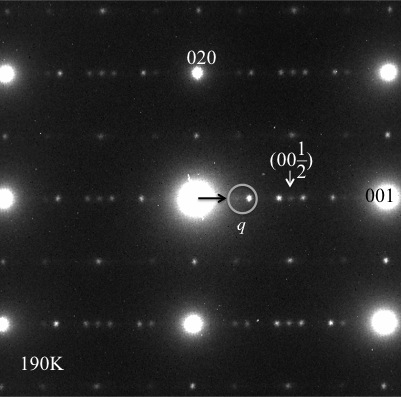
Fig. 2: [100]-zone-axis diffraction pattern taken at the same sample region to Figure1 at otherwise 190 K,showing the emergence of incommensurate satellite peaksas indicated by the white circle. |
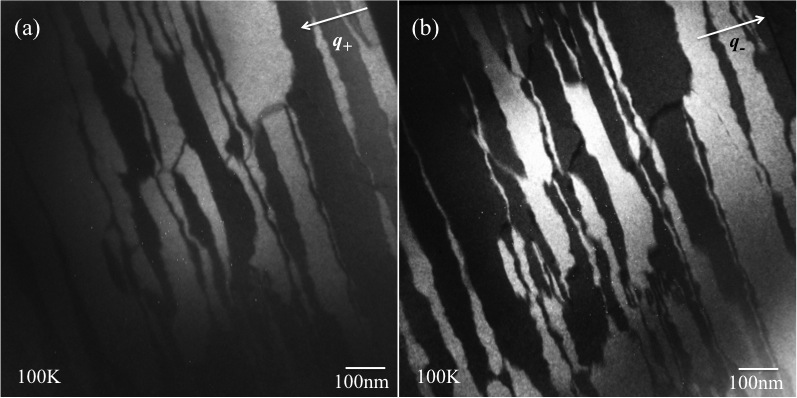
Fig. 3: (a) and (b), the superlattice dark-field TEM images obtained from the respective commensurate q+ = (0, 0,¼)and q- = (0, 0, –¼) vectors in Figure 1 as a result of the symmetry breaking along c axis upon the CDW modulation. |
|