MS-4-P-2649 TEM Investigation on the Surface Oxide Layer of an Annealed AISI-316L Stainless Steel Microfiber
Steel fibre reinforced polymers are gaining considerable attention because of their remarkable flexural strength, fatigue resistance and the ability to tailor directional mechanical properties. Here, we investigate an annealed AISI-316L stainless steel microfiber sample using advanced electron microscopy and spectroscopy to understand the chemical composition and morphology of surface oxide layers on these fibres. When a steel fibre surface is thermally treated or even simply exposed to natural atmospheric conditions, a thin layer of oxide is instantaneously formed at the surface of the steel. This oxide layer not only plays an important role in protecting the steel from further corrosion, [1] but also acts as the interface with the matrix when using these fibres in composite materials. There are several literature reports which explain the effect of annealing on the thickness of the oxide layer [2]. The objective of the present study was to characterize this surface layer using HRTEM in combination with energy-dispersive X-ray (EDX) analysis and electron energy loss spectroscopy (EELS). SEM images from the surface of the steel microfibers showed the presence of small chromium rich particles with spinel structure and spherical morphologies. TEM specimens for the studies were prepared using Focussed Ion Beam (FIB) technique enabling the preparation of cross-section as well as on-axis samples. HRTEM images showed the presence of a very narrow gradient surface oxide layer with approximately 5.0 nm thickness at the surface of the steel fibre. EDX analysis revealed that this narrow gradient consists of three sublayers – an external layer rich in iron, an intermediate layer rich in chromium and an inner layer rich in nickel. ELNES studies reveal that the fine structure of the Fe-L2, 3, Cr-L2, 3 and Ni-L2, 3 edges obtained from the surface are different from those obtained from the bulk of the alloy, confirming the oxidised character of the surface layer. The insight gained from these studies is valuable considering the fact that these types of metal fibre alloys are widely used commercially.
References:
[1.] G. Renaud, Oxide surfaces and metal/oxide interfaces studied by grazing incidence X-ray scattering, Surface Science Reports, 32, 1-90 (1998).
[2.] H. Singh, D. Puri, S. Prakash, Rabindranath Maiti, Characterization of oxide scales to evaluate high temperature oxidation behavior of Ni–20Cr coated superalloys, Materials Science and Engineering A, 464, 110–116 (2007).
The authors would like to thank the Strategic Innovative Materials (SIM) project for the support through research projects.
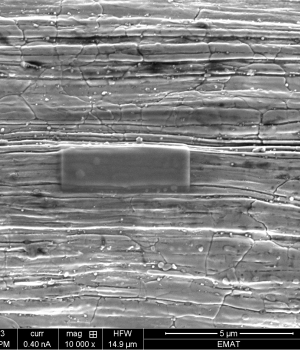
Fig. 1: SEM image showing particles on the surface of AISI-316L stainless steel microfibre. |
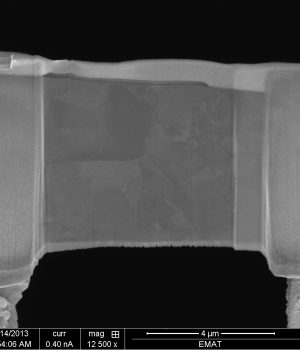
Fig. 2: SEM image of a cross-section of AISI-316L stainless steel microfiber. |
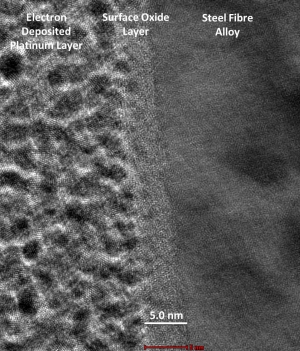
Fig. 3: HRTEM image of an oxide layer formed on the surface of AISI-316L stainless steel microfibre. |
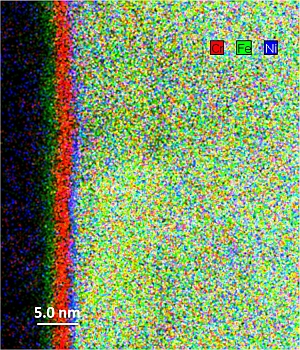
Fig. 4: EDX map of the phases present within the surface oxide layer formed on AISI-316L stainless steel microfibre. |