MS-8-O-2549 High-Resolution Transmission Electron Microscopy Imaging and Raman Spectroscopy of Two-Dimensional Transition-Metal Dichalcogenides
We present a study of some structural and optical characteristics of two-dimensional transition-metal dichalcogenides. The study includes aberration-corrected high-resolution transmission electron microscopy (HRTEM) imaging and Raman spectroscopy measurements of molybdenum disulfide (MoS2), molybdenum diselenide (MoSe2), and tungsten diselenide (WSe2) films. The measurements examine the in-plane crystal structure and vibrational modes of these materials. Our results contribute several intrinsic characteristics for these materials, and thus enable further investigations of their potential for applications.
Samples for the HRTEM experiments were prepared directly from natural, bulk MoS2 and from synthetic bulk MoSe2 and WSe2 single crystals to minimize introducing defects that might arise from the usual transfer of the samples from a separate substrate onto a TEM grid. The imaging work is carried out in an image-aberration-corrected FEI Titan G2 80-300 transmission electron microscope that is capable of atomic resolution. Micrographs of monolayer MoS2, few-layer MoSe2, and WSe2 are shown, respectively, in Figures 1(a) through 3(a). Using these direct images and an analysis of their Fourier transforms, one can identify the hexagonal crystal structure of the films. Furthermore, it becomes trivial to extract the in-plane lattice parameters from the direct images; these agree with values that are theoretically calculated [1].
Several monolayer and few-layer MoS2, MoSe2, and WSe2 samples were prepared for Raman spectroscopy to investigate the vibrational modes of the films [2]. The Raman measurements were performed using a Renishaw inVia Raman system equipped with a 532-nm laser as an excitation source; this system has a resolution of ~1cm-1. By monitoring the peak spectral location of the Raman modes, it was possible to determine the approximate number of layers in few-layer samples of the dichalcogenides—similar to what is done in graphene [3]. Each sample of MoS2, MoSe2, or WSe2 exhibits two characteristic Raman modes; these are indicated in Figures 1(b) through 3(b). A correlation and analysis of these modes as a function of sample thickness provide useful insight into the layer-to-layer interactions in the materials.
These experimental results provide a useful data set for understanding some of the intrinsic properties of two-dimensional transition-metal dichalcogenides.
References:
[1] Wilson and Yoffe, Advances in Physics, 18:73, 193-335 (1969).
[2] K.S. Novoselov, et al., Science 306, 666-669 (2004).
[3] A.C. Ferrari, et al., Phys. Rev. Lett. 97, 187401 (2006).

Fig. 1: (a) HRTEM image of monolayer MoS2, including the extracted in-plane lattice constant. The fast Fourier transform of the area outlined by the white dashed box is inset. (b) Raman spectra of monolayer, few-layer, and bulk MoS2, with vibrational modes A1g and E12g labeled. Dashed lines indicate the approximate spectral location of the bulk peaks. |
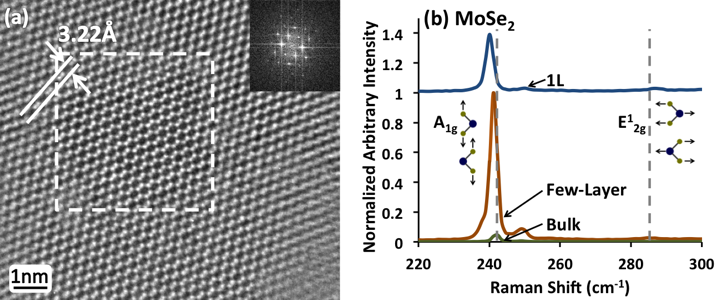
Fig. 2: (a) HRTEM image of few-layer MoSe2, including the extracted in-plane lattice constant. The fast Fourier transform of the area outlined by the white dashed box is inset. (b) Raman spectra of monolayer, few-layer, and bulk MoSe2, with vibrational modes A1g and E12g labeled. Dashed lines indicate the approximate spectral location of the bulk peaks. |

Fig. 3: (a) HRTEM image of few-layer WSe2, including the extracted in-plane lattice constant. The fast Fourier transform of the area outlined by the white dashed box is inset. (b) Raman spectra of monolayer, few-layer, and bulk WSe2, with vibrational modes A1g and E12g labeled. Dashed lines indicate the approximate spectral location of the bulk peaks. |
|