MS-4-P-2310 Understanding the failure of oxidized grain boundaries
Stress Corrosion Cracking (SCC) of Alloy 600 (Ni-base alloy) in Pressurized Water Reactors (PWRs) is known to be one of the most expensive and challenging phenomena in the nuclear industry. SCC is difficult to observe, investigate and predict and often it occurs although no obvious signs of corrosion are present. Over the last decades great research efforts have been made to understand SCC of Alloy 600 under PWR conditions and many mechanisms based on different theories have been proposed to explain crack initiation and propagation. One thing they all have in common is the lack of definite experimental proof in favour of one of them. Although Alloy 600 suffers from intergranular failure under PWR primary water conditions, experimental evidence capable of explaining the failure mechanism and its link to microstructure is still insufficient. A combination of detailed microscopy investigations and micromechanical testing of individual grain boundaries (GBs), oxidized in simulated PWR primary water, now provides a novel tool for studying the specific fracture behaviour (e.g. brittle failure, plastic deformation etc.) of oxidized GBs. Utilizing a recently developed novel approach to fabricate and micromechanically test micron-sized cantilevers (Figure 1), we are now able to obtain information about the elastic moduli, yield stress and fracture toughness of tested GBs. The same GBs are also characterized by 3D FIB Slicing and (S)TEM, thus enabling the correlation of their measured mechanical response to the specific 3D microstructure and degree of oxidation (Figure 2). This includes the extraction of the grain orientations via Selected Area Diffraction (SAD) as well as analytical mapping of the grain boundary region after testing (Figure 2), providing further insights on how the crack propagates. Employing the crystal plasticity Finite Element Method (CPFEM) the experimental data can then be used to gain quantitative information about the SCC initiated failure of GBs by building realistic computer models of the fracture experiments. These models enable us to not only simulate the basic fracture experiments but also to consider the realistic plastic response of the tested microcantilevers. The presented approach consequently allows for the quantification of the stress necessary to fracture individual oxidized GBs and adds valuable qualitative and quantitative data to the study of stress corrosion cracking as well as the role of (intergranular) oxidation with unprecedented detail.
The authors want to thank INSS (Japan) and EDF (France) for the provision and autoclave testing of the samples. EDF is further acknowledged for the financial support of this work.
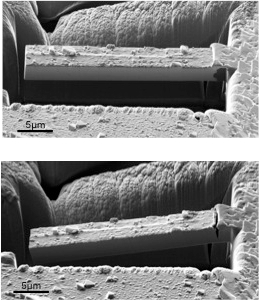
Fig. 1: SEM images of a FIB-machined microcantilever before (top) and after (bottom) the micromechanical bending test. The bottom image shows how the oxidized portion of the grain boundary failed intergranularily after testing. |
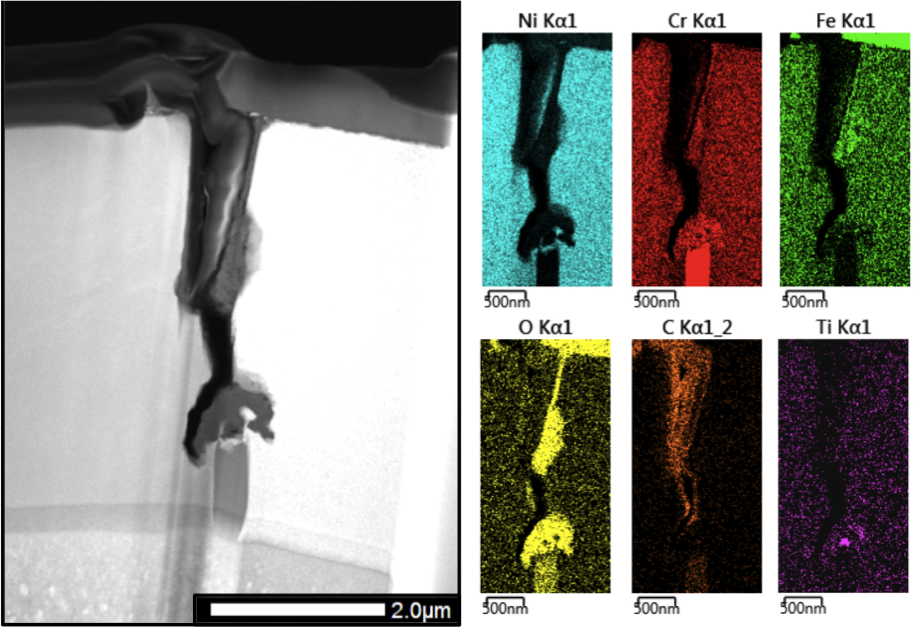
Fig. 2: HAADF image of the crack region along an oxidized GB after the test (left). EDX elemental maps revealing the chemistry of the GB region (right). The results show that (a) the oxide grows along the GB and around a carbide, (b) the crack proceeds along the metal/oxide interface and (c) that the crack stops exactly where the oxide vanishes. |