MS-2-O-2002 Measuring the temperature dependence of the Debye–Waller Factor in Graphene using electron diffraction techniques.
Within the thermodynamic limit lattice vibrations in a two dimensional (2D) crystal should destroy any long range order. As such prior to the isolation of monolayer graphene in 2004, 2D crystals were thought impossible to realise.[1] In order to explain the surprising stability of 2D crystals it is necessary to establish a detailed understanding of their lattice vibrations and how they might be affected by the properties of the crystal, for example domain size or defect density.
To date there have been many theoretical predictions of the phonon band structure of graphene with supporting experimental evidence from Raman spectroscopy measurements.[2] Recently the mean-square displacement (or Debye-Waller factor) of graphene atoms from their equilibrium lattice position has been measured from electron diffraction patterns.[3]
Using in-situ heating and cooling TEM holders we have recorded diffraction patterns from single crystals of mono-layer graphene at varying tilt angles and temperatures ranging from 100K – 1500K (figure 1). Careful analysis of these diffraction patterns has allowed us to extract values for the in-plane mean square displacement (Debye-Waller factor) of atoms over the whole temperature range. By studying the tilt dependence of the diffraction spot intensity we have also measured the out of plane atomic displacements relating to the flexural phonon modes of the graphene lattice.
We compare our results to theoretical predictions for the Debye-Waller factor based on calculations of the phonon-dispersion relation of graphene and comment on the validity of these models over the temperature range investigated.
[1] L.D. Landau et al. Statistical Physics . Part I (Butterworth-Heinemann, Amsterdam, 2003)
[2] E. Pop et al. MRS Bull. 37, 12, 1273-1281 (2012)
[3] B. Shevitski et al. Phys. Rev. B. 87,045417, (2013)
The research leading to these results has received funding from the European Union Seventh Framework Programme under Grant Agreement 312483 - ESTEEM2 (Integrated Infrastructure Initiative¬I3).
References
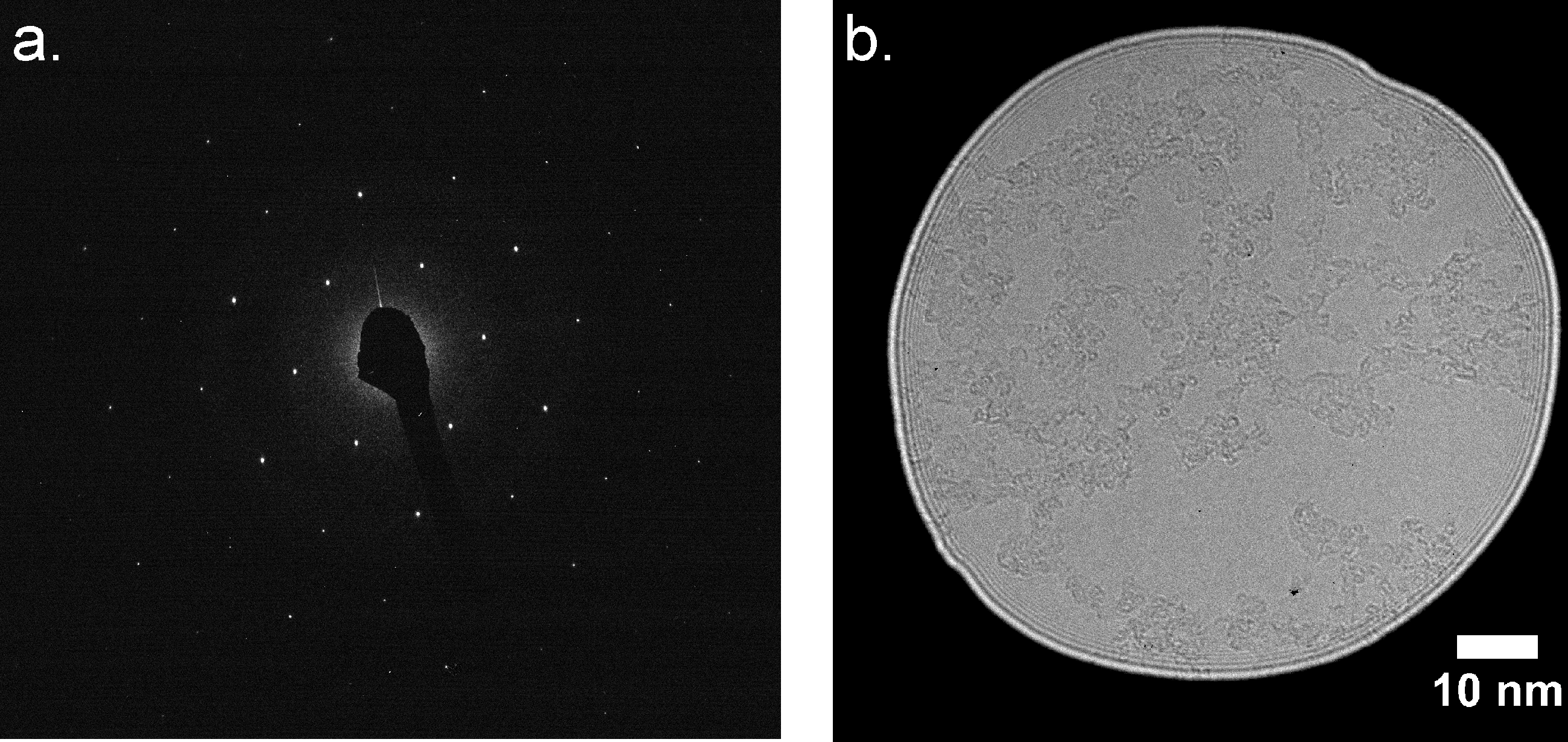
Fig. 1: Figure 1. a. Selected area diffraction pattern of mono-layer graphene taken at room temperature and zero tilt. b. Real space TEM image of the graphene sample imaged through the selected area aperture used for diffraction. |