MS-2-P-1752 Atom-by-atom STEM EELS investigation of n- and p- doped graphene.
Graphene, or the miracle material as it has become known, has promised to revolutionize the world of electronics by replacing Si-based technology [1,2]. Graphene however is an excellent conductor – often described as a ‘zero bandgap’ semiconductor, an attribute which so far limits its widespread application in devices. Among various solutions to tailor its properties for practical implementation, the introduction of dopants in the graphene lattice is predicted to have a drastic effect on graphene's band structure [3], such as the opening of an optical bandgap or an increase in charge carrier density resulting in n- or p-type doping, with carrier concentrations allowing practical transistor applications. The introduction of dopants such as N in graphene is most commonly achieved during the chemical growth process, with varying levels of success regarding the purity of the samples, which often contain contaminants, defects and secondary impurities. We have recently demonstrated an alternative, cleaner method by successfully doping freestanding single layer graphene with N and B through low energy ion implantation [4], achieving retention levels of the order of ~1%.
In this work we use STEM-based spectroscopy [5,6], to study the impact of single N or B dopant atoms on the electronic structure of the graphene membrane. Z-contrast imaging and atomically resolved electron energy loss spectroscopy were performed in a Nion UltraSTEM100 dedicated STEM instrument and were used to unambiguously identify single dopant atoms (fig. 1) and to determine the doping levels as a function of ion implantation energy and flux. Furthermore, the electronic structure modifications due to the presence of these dopant B or N atoms are strikingly demonstrated by a clear signature in the near-edge fine structure of the B and N EELS K edges but also that of C K edge of neighboring C atoms (fig. 1). Ab initio calculations are used to simulate experimental spectra (fig. 2) and to rationalize the experimental observations, thus providing further insight into the nature of bonding around the foreign species.
[1]A. K. Geim et al., Nat Mater 6, 183 (2007).
[2]K. Kim et al., Nature 479, 338 (2011).
[3]S. Casolo et al., Nanostructured Mater 115, 1 (2010).
[4]U. Bangert et al., Nano Lett 13, 4902 (2013).
[5]Q. M. Ramasse et al., Nano Lett 13, 4989 (2013).
[6]R. J. Nicholls et al., ACS Nano 7, 7145 (2013).
SuperSTEM is the UK National Facility for Aberration-Corrected STEM and is funded by the UK Engineering and Physical Sciences Research Council (EPSRC)
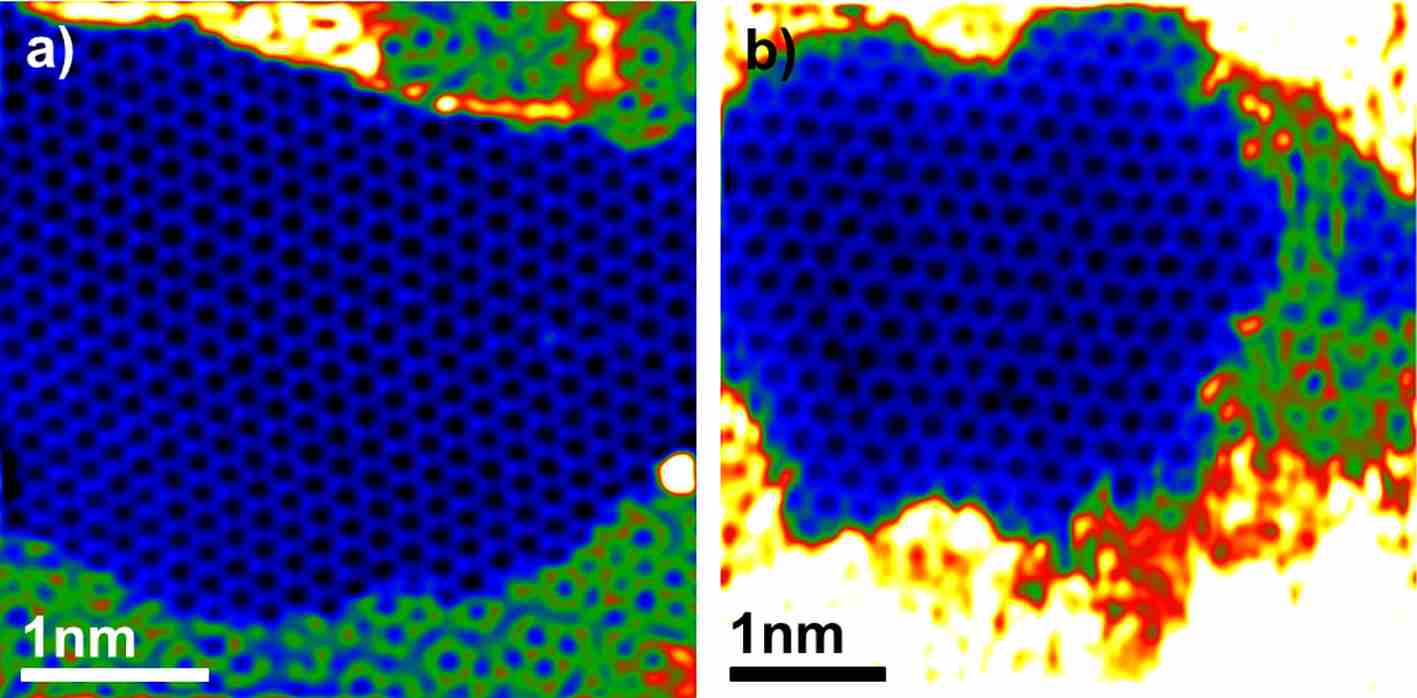
Fig. 1: HAADF STEM images of a) N and b) B implanted graphene showing single N and B substitutions in the graphene lattice, respectively. The images were low-pass filtered and colorised for clarity. |
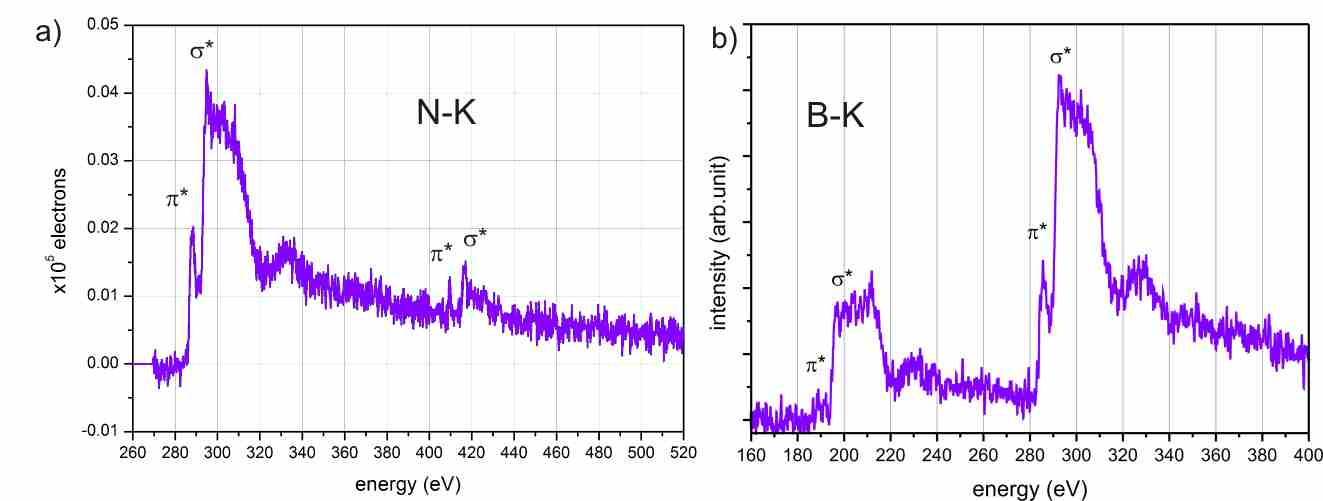
Fig. 2: EEL spectra from a) N and b) B implanted graphene samples, showing the near edge fine structure of the C K, N K edges and B K and C K edges of the N- and B-doped sample, respectively. |