MS-2-P-1483 Structural Analysis of Electron-Beam-Irradiated C60 Single Crystal Films Using High-Resolution Transmission Electron Microscopy and Electron Diffraction
We have found that one-dimensional (1D) uneven peanut-shaped C60 polymer is formed by electron-beam (EB) irradiation of a pristine C60 film [1], and exhibits novel physical properties arising from 1D metal, such as the geometric curvature effects on the Tomonaga-Luttinger liquid states [2]. For the polymer structure, in situ infrared (IR) spectra and density-functional calculations suggested the 1D polymer has a cross-linked structure (Fig. 1(c)) roughly close to that of the P08 C120 isomer (Fig. 1(b)) obtained from the general Stone-Wales transformation [3]. Although the previous results indicated the polymer to have 1D peanut-shaped structure, we have examined the structure of the 1D polymer formed from a C60 single crystal (SC) film more precisely, using HRTEM and electron diffraction (ED).
The 1D C60 polymer film was formed on a mica substrate by EB irradiation of a pristine C60 SC film in an UHV chamber. After confirmed that all C60 molecules were polymerized to form the 1D polymer using in situ IR spectroscopy, we ripped the film off the mica and mounted it on a Cu mesh in air, and observed the film by TEM.
Figure 2 shows HRTEM images and ED patterns of the pristine and the EB-irradiated C60 films. The C60 film is a FCC SC with [111] orientation, which contains twins as stacking faults on (111), and shows weak spots E1 and E2 as 1/3 and 2/3 of 422 series, respectively. The EB-irradiated C60 SC film shows three new features. Firstly, E1 and E2 become intense, indicating symmetry reduction and FCC transferred to HCP. Secondary, spots of 220 series become doublet. Since the corresponding distance of these spots is 5.0 Å and 4.6 Å, respectively, the intermolecular distance (di) between adjacent C60 molecules is estimated to be 10.0 Å and 9.3 Å for each. Finally, each spot becomes an arc-like stretched line of ca. 9.2°. This arises from a slight loss of the orientation. These results show the asymmetric shrinkage of crystal structure along one given direction.
C60 FCC structure changes to 1D polymer BCO (Fig. 1(d)). Furthermore, judging from the intense E1 spot, BCO changes to HCP-m (Fig. 1(e)). Figs. 2(e, f) show the simulated ED patterns of BCO and HCP-m based 1D C60 polymer model (the di of 9.3 Å) with 3-fold symmetry derived from three possible polymerization directions on (111) of FCC C60 SC film, using QSTEM code [4]. Since each pattern well reproduces the experimental ED pattern, a mixed stacking model of BCO and HCP-m 1D C60 polymer structures is suitable for the EB-irradiated C60 SC film [5].
[1] J. Onoe et al., Appl. Phys. Lett. 82, 595 (2003).
[2] J. Onoe et al., Europhys. Lett. 98, 27001 (2012).
[3] A. Takashima et al., J. Phys. D: Appl. Phys. 45, 485302 (2012).
[4] C. Koch, Ph.D. thesis (2002).
[5] H. Masuda et al., to be submitted.
This work was supported by “Advanced Characterization Nanotechnology Platform (MEXT)” at Osaka University and by the collaborative research fund of J-Power.

Fig. 1: Molecular models of C60 (a), P08 C120 isomer (b), 1D C60 polymer (c). The unit cell of 1D C60 polymer with body-centered orthorhombic structure (BCO) (d), and hexagonal closed-packed-based monoclinic structure (HCP-m). |
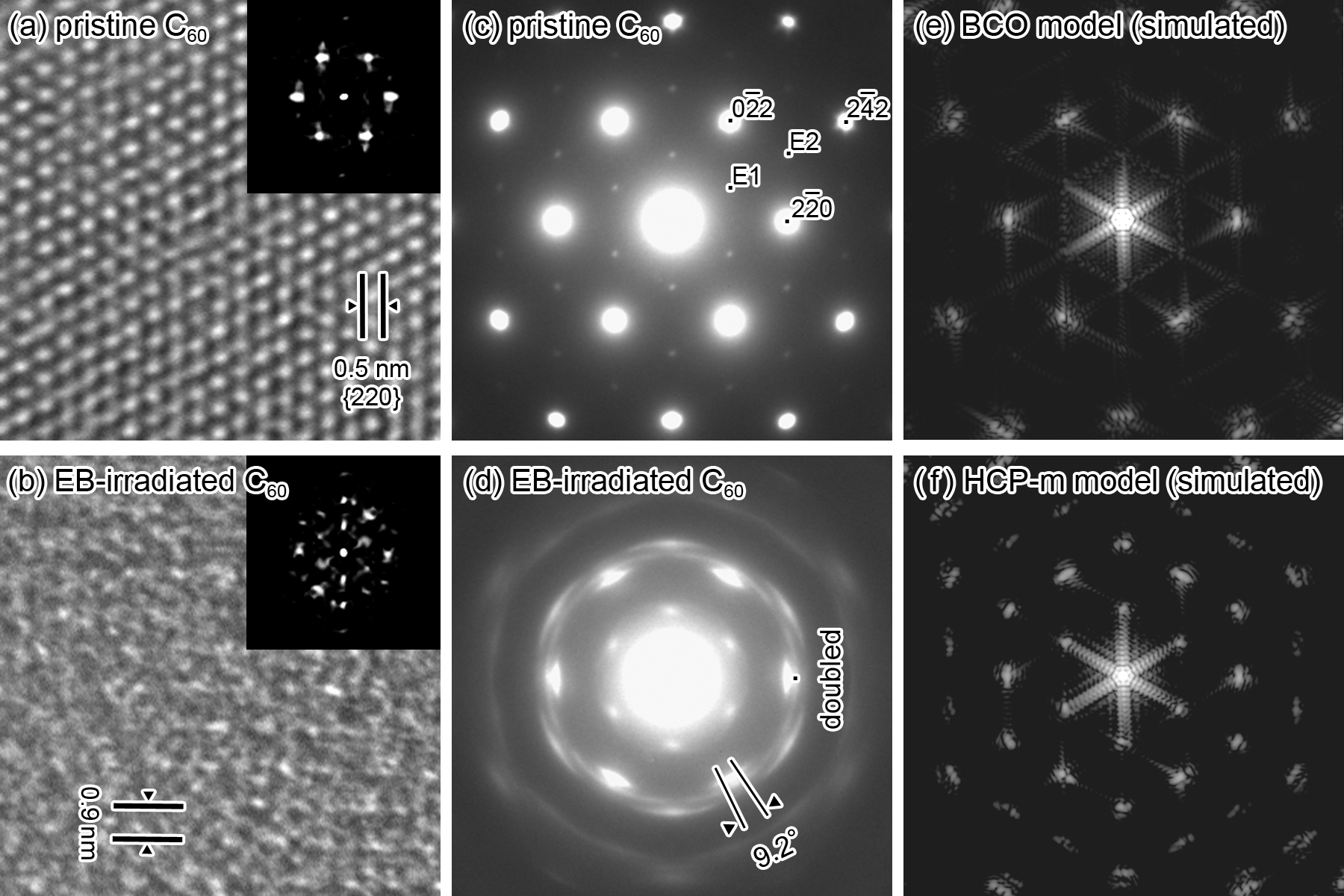
Fig. 2: Experimental HRTEM images (insets: FFT patterns) and ED patterns of pristine C60 SC (a, c), EB-irradiated C60 SC (b, d), simulated ED patterns using 1D C60 polymer model with intermolecular distances of 9.3 Å in polymer direction (e, f). |